COE Guide

COE Prices 2025: Trends, Analysis & What to Expect

COE prices in Singapore have remained at historically elevated levels in 2025, with Category B prices consistently above S$100,000. Here’s a detailed analysis of the current market and what to expect going forward.

Current COE Prices (April 2025)

  • Category A (Small Cars): S$123,010
  • Category B (Large Cars): S$121,001
  • Category C (Commercial Vehicles): S$83,501
  • Category D (Motorcycles): S$9,290
  • Category E (Open): S$125,002

Key Factors Driving COE Prices

1. Vehicle Population Growth Cap

The LTA limits the growth of Singapore’s vehicle population to 0% (effectively keeping it flat). This means the number of new COEs issued each year is tightly controlled, creating scarcity and supporting high prices.

2. Strong Demand for New Vehicles

Despite high COE prices, demand for new vehicles remains robust, driven by rising household incomes and the desire for newer, more fuel-efficient models.

3. Electric Vehicle (EV) Adoption

The growing popularity of EVs has increased competition for Category A and B COEs, as many popular EV models fall into these categories.

4. Commercial Vehicle Demand

Strong logistics and e-commerce growth has kept Category C (commercial vehicle) COE prices elevated.

Price Outlook for 2025

Based on current trends and LTA’s quota announcements:

  • Short-term (Q2 2025): Prices likely to remain stable or slightly increase due to continued strong demand.
  • Medium-term (H2 2025): Potential for modest price corrections if LTA increases quotas or demand softens.
  • Long-term: COE prices are expected to remain elevated as Singapore maintains its vehicle population cap.

What This Means for COE Renewal

With PQP rates tracking the high bidding prices, COE renewals are more expensive than ever. However, the alternative โ€” buying a new vehicle with a fresh COE โ€” is even more expensive. For many vehicle owners, renewal remains the more cost-effective option.

Planning Your COE Renewal

Given the current price environment, we recommend:

  1. Start planning your renewal 6-12 months in advance
  2. Lock in financing early to take advantage of current rates
  3. Consider a 10-year renewal if your vehicle is in good condition
  4. Bundle your renewal with insurance for potential savings

Contact COE Plus for a free consultation on your COE renewal strategy.


Ready to Renew Your COE?

Join 5,000+ satisfied customers who renewed their COE through COEPLUS โ€” completely free of charge. Get your personalised quote in minutes.

Read More...

Electric Vehicles and COE: What EV Owners Need to Know

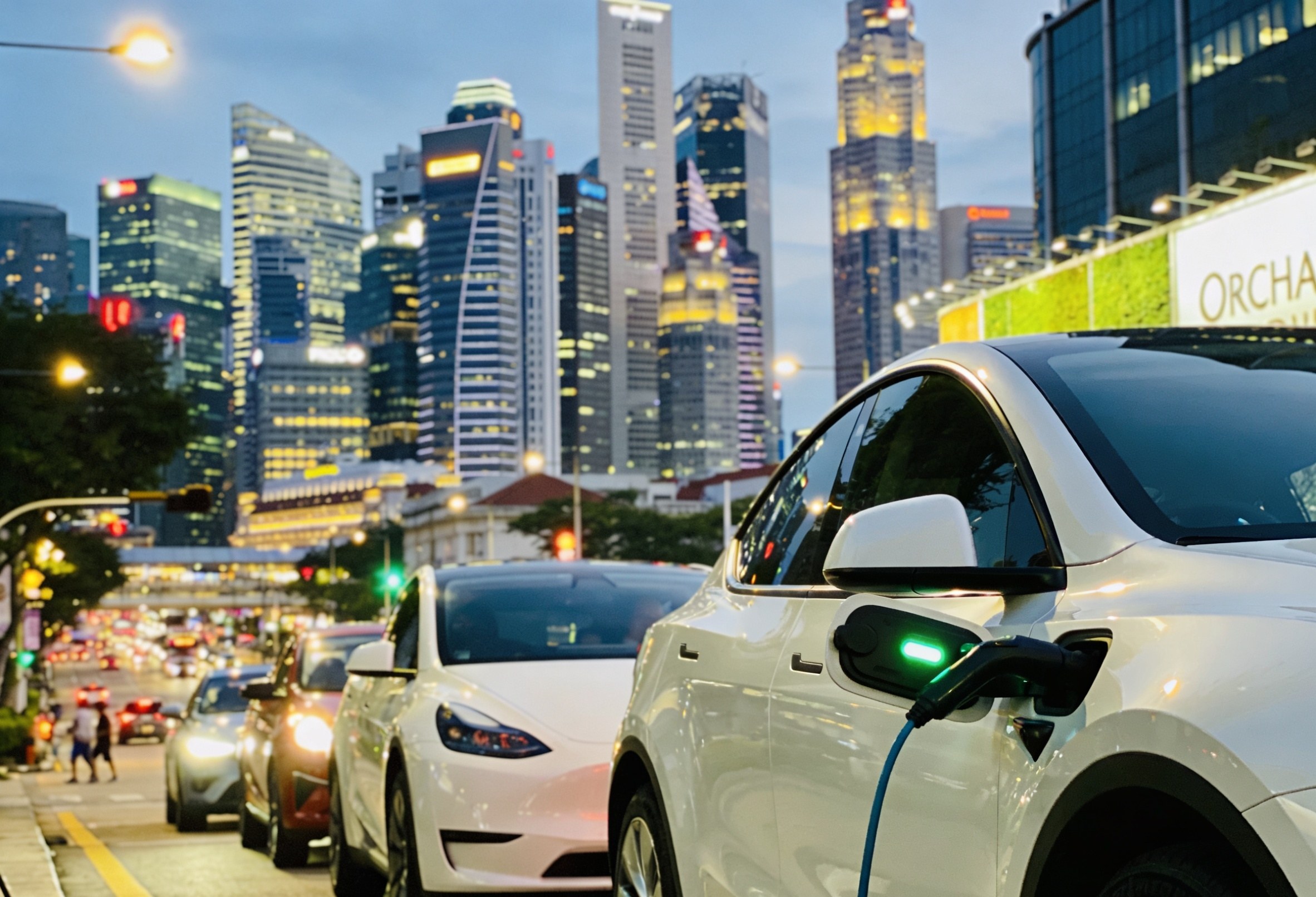
Singapore’s push towards electric vehicles (EVs) has created new considerations for COE planning. Whether you’re buying a new EV or renewing the COE on an existing one, here’s what you need to know.

Which COE Category Do EVs Fall Under?

EV COE categorisation is based on maximum power output, not engine capacity (since EVs don’t have traditional engines):

  • Category A: EVs with maximum power output not exceeding 97kW (e.g., some BYD models, Hyundai Ioniq 5 Standard Range)
  • Category B: EVs with maximum power output exceeding 97kW (e.g., Tesla Model 3, BYD Atto 3, Hyundai Ioniq 6)
  • Category E: High-performance EVs (e.g., Tesla Model S, Porsche Taycan)

Government Incentives for EVs

EV Early Adoption Incentive (EEAI)

The government has offered various incentives to encourage EV adoption, including rebates on the Additional Registration Fee (ARF). Check the LTA website for the latest incentive schemes.

Road Tax Rebates

EV owners enjoy road tax rebates as part of the government’s push to reduce carbon emissions.

Charging Infrastructure

Singapore is rapidly expanding its EV charging network, with targets for widespread charging availability by 2030.

COE Renewal for EVs

When your EV’s COE expires, the renewal process is the same as for conventional vehicles:

  • Pay the PQP for your vehicle’s COE category
  • Choose between 5-year and 10-year renewal
  • Arrange financing if needed

Special Considerations for EV COE Renewal

Battery Condition

Before renewing your EV’s COE, have the battery health assessed. EV batteries degrade over time, and a battery with significantly reduced capacity may affect the vehicle’s value and your decision to renew.

Battery Replacement Costs

Factor in potential battery replacement costs when deciding on COE renewal. A new EV battery can cost S$15,000โ€“S$40,000 depending on the model.

Technology Obsolescence

EV technology is evolving rapidly. A 10-year-old EV may have significantly less range and fewer features than current models. Consider whether the technology will remain relevant for your needs.

Is COE Renewal Worth It for EVs?

The decision depends on:

  • Battery health and remaining capacity
  • Cost of battery replacement vs. new vehicle
  • Available government incentives for new EVs
  • Your driving needs and range requirements

Get Expert Advice

COE Plus has specialists who understand the unique considerations for EV COE renewal. Contact us for a free consultation tailored to EV owners.


COE Renewal Calculator

Estimate your renewal cost & monthly repayments

%
% p.a.
Current PQP (Cat A): S$119,432


Ready to Renew Your COE?

Join 5,000+ satisfied customers who renewed their COE through COEPLUS โ€” completely free of charge. Get your personalised quote in minutes.

Read More...

Understanding COE Categories: A to E Explained

Singapore’s COE system divides vehicles into five categories, each with its own quota and bidding price. Understanding which category applies to your vehicle is essential for planning your COE renewal.

Understanding COE Categories In Singapore

Category A โ€” Small Cars

Vehicles covered: Cars with engine capacity up to 1,600cc AND maximum power output not exceeding 97kW (about 130 bhp).

Examples: Toyota Vios, Honda Jazz, Mazda 2, Volkswagen Polo

Current PQP: Approximately S$121,000

Category A COEs are typically cheaper than Category B, making them popular for budget-conscious buyers. However, the price difference has narrowed significantly in recent years.

Understanding COE Categories

Category B โ€” Large Cars

Vehicles covered: Cars with engine capacity above 1,600cc OR maximum power output exceeding 97kW.

Examples: Toyota Camry, Honda Accord, BMW 3 Series, Mercedes C-Class

Current PQP: Approximately S$119,000

Category B is the most popular COE category for mid-size and luxury vehicles. Prices have historically been among the highest due to strong demand.

Understanding COE Categories

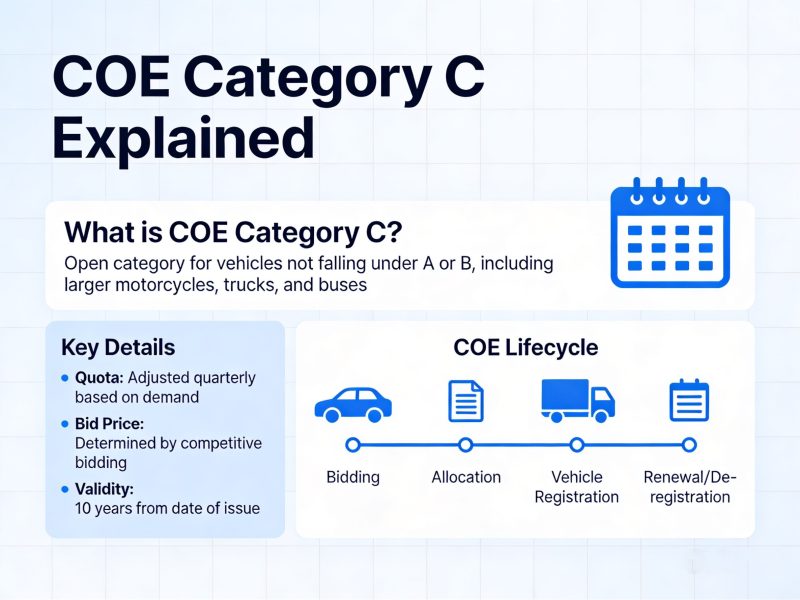
Category C โ€” Goods Vehicles & Buses

Vehicles covered: Goods vehicles and buses.

Examples: Lorries, vans, pickup trucks, minibuses, school buses

Current PQP: Approximately S$82,000

Category C COEs are essential for businesses that rely on commercial vehicles. The quota is typically smaller than passenger car categories.

Understanding COE Categories

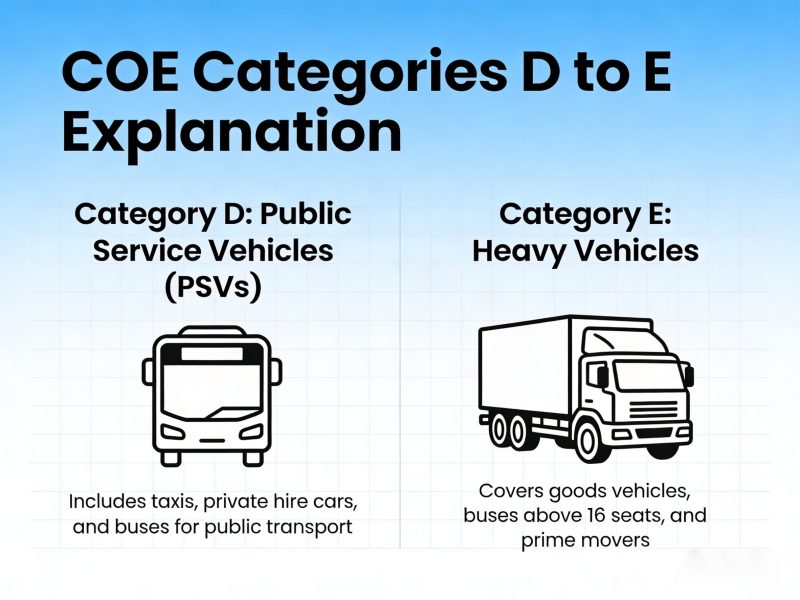
Category D โ€” Motorcycles

Vehicles covered: All motorcycles.

Examples: Honda CB500, Yamaha MT-07, Kawasaki Ninja

Current PQP: Approximately S$9,100

Category D has the lowest COE prices of all categories, reflecting the lower cost of motorcycles compared to cars.

Category E โ€” Open (All Vehicles)

Vehicles covered: Any vehicle type โ€” the most flexible category.

Current PQP: Approximately S$123,000

Category E COEs can be used for any vehicle type. They are typically the most expensive category due to their flexibility and are often used for luxury or high-performance vehicles that exceed Category B specifications.

Which Category Do I Need?

Your vehicle’s COE category is determined at the time of registration and cannot be changed. When renewing your COE, you will renew in the same category as your original COE.

Use our COE Renewal Calculator to estimate your renewal costs based on your vehicle’s category.


Ready to Renew Your COE?

Join 5,000+ satisfied customers who renewed their COE through COEPLUS โ€” completely free of charge. Get your personalised quote in minutes.

Read More...
COEPLUS.COM: Renew Your COE!

What Is COE

๐Ÿ“š Educational Guide ยท COEPLUS.COM

What is COE? A Complete Guide for Singapore Vehicle Owners

โฑ 4 min read๐Ÿ“… Updated June 2026โœ… Verified by COEPLUS Team

Homeโ€บResourcesโ€บWhat is COE?

What is COE?

COE stands for Certificate of Entitlement. It is a licence granted by Singapore’s Land Transport Authority (LTA) that gives the holder the right to own and operate a vehicle on Singapore’s roads for a period of either 5 or 10 years.

Without a valid COE, a vehicle cannot be legally registered or driven in Singapore. When you buy a new car in Singapore, the COE cost is included in the purchase price. When your COE expires, you must either renew it (pay for a new COE) or deregister the vehicle and scrap or export it.

Simple definition: COE is essentially a time-limited licence to own a vehicle in Singapore. You are not buying the vehicle outright โ€” you are also buying the right to use it on the road for a fixed period.

Why Does Singapore Have COE?

Singapore is one of the most densely populated cities in the world, with a land area of just 733 kmยฒ. Unlike most countries, Singapore uses the COE system to actively manage the total number of vehicles on its roads.

The COE system was introduced in 1990 by LTA as part of the Vehicle Quota System (VQS). The goal is straightforward: by controlling how many new vehicles are registered each year, Singapore keeps traffic congestion manageable and roads functional.

Each month, LTA determines how many new COEs are available based on deregistrations and transport planning targets. This quota is then auctioned through a competitive bidding exercise โ€” and the price you pay is determined entirely by demand.

Key insight: COE prices are not set by the government. They are determined by market forces โ€” specifically, by how much Singapore buyers are willing to bid. High demand for new cars drives COE prices up; low demand brings them down.

COE Categories Explained

LTA divides vehicles into five categories, each with its own COE quota and bidding price:

Category Vehicle Type Common Examples
Cat A Cars up to 1,600cc engine capacity AND up to 130bhp Toyota Vios, Honda Jazz, Mazda 2
Cat B Cars above 1,600cc OR above 130bhp BMW 3 Series, Toyota Camry, Volvo XC60
Cat C Goods vehicles and buses Vans, lorries, buses
Cat D Motorcycles All motorcycles and scooters
Cat E Open category โ€” any vehicle except motorcycles Can be used for any Cat Aโ€“C vehicle

Cat E COEs are the most flexible but typically the most expensive, as they can substitute for any other category. Many buyers of Cat B vehicles end up bidding in Cat E if Cat B prices are lower there, or vice versa.

How the Bidding System Works

LTA conducts COE bidding exercises on the 1st and 3rd Wednesday of every month. Each exercise runs for two days, and the results are published on the LTA website.

You do not need to bid yourself. When you buy a new vehicle from a dealer or apply for COE renewal through COEPLUS, your agent handles the bidding on your behalf. You simply pay the final COE price.

The bidding system works as follows:

  1. LTA announces the available quota for each category before each exercise.
  2. Buyers (or their authorised dealers/brokers) submit sealed bids stating the maximum amount they are willing to pay.
  3. At the end of the bidding period, all successful bidders pay the same price โ€” the Quota Premium (QP), which is the lowest successful bid that clears the available quota.
  4. Unsuccessful bidders (those who bid below the clearing price) do not get a COE and must try again in the next exercise.

COE and Vehicle Renewal

Every COE has a 10-year lifespan (or 5 years if you chose a shorter term). When it expires, you have three options:

  • Renew for 5 years โ€” pay 50% of the current Prevailing Quota Premium (PQP)
  • Renew for 10 years โ€” pay 100% of the current PQP
  • Deregister the vehicle โ€” scrap it or export it, and claim any applicable PARF rebate

The PQP (Prevailing Quota Premium) is not the same as the latest bid price. It is a 3-month moving average of COE prices for the relevant category. This makes renewal costs more predictable and less volatile than if they tracked the latest bidding result directly.

๐Ÿ“Œ As of June 2026, the Cat A PQP is approximately S19,432. Use the COEPLUS Calculator below to see your exact renewal cost with current live data.

How COE Affects Your Vehicle Costs

COE is one of the largest costs of owning a vehicle in Singapore. For a Cat A vehicle with a PQP of S19,432, the 10-year renewal cost alone is over S19,000 โ€” before financing costs. This is why financing the COE through a bank loan is extremely common.

Cost Component What It Is Typical Amount (Cat A)
COE (PQP) The certificate itself ~S19,432 (10-year)
COE Loan Interest If financed via bank ~S,000โ€“10,000 over 7 yrs
Road Tax Annual fee to use the road S00โ€“2,000/year
Insurance Annual vehicle insurance S00โ€“2,500/year
Servicing Annual maintenance S00โ€“1,500/year

The COE system means that Singapore has some of the highest vehicle ownership costs in the world โ€” but also some of the best-maintained road networks and lowest congestion levels among major global cities.

Ready to Calculate Your COE Renewal Cost?

Use the free COEPLUS Calculator to see your exact monthly repayment using the latest live PQP data.


Read More...
Vibrant historic building with multicolored windows at dusk, Singapore City street view.

Understanding PQP: How Your COE Renewal Cost Is Calculated

๐Ÿ“š Educational Guide ยท COEPLUS.COM

Understanding PQP: How Your COE Renewal Cost Is Calculated

โฑ 3 min read๐Ÿ“… Updated June 2026โœ… Verified by COEPLUS Team

Homeโ€บResourcesโ€บUnderstanding PQP

What is PQP?

PQP stands for Prevailing Quota Premium. It is the price used to calculate how much you pay when you renew your COE. If you are renewing for 10 years, you pay 100% of the PQP. If you are renewing for 5 years, you pay 50% of the PQP.

Simple rule: Your COE renewal cost = PQP ร— renewal multiplier (1.0 for 10 years, 0.5 for 5 years). The PQP is determined by LTA, not by your dealer or broker.

How PQP is Calculated

The PQP is a 3-month moving average of the Quota Premium (QP) from the most recent three bidding exercises for the same COE category.

In practice, this means:

  1. LTA looks at the QP (winning bid price) from each of the last 3 bidding exercises for your category
  2. It calculates the simple average of those 3 figures
  3. That average becomes the PQP used for renewals processed during the current month
Example: If Cat A COE clearing prices in the last 3 exercises were S18,000, S21,000, and S19,296, the PQP would be (118,000 + 121,000 + 119,296) รท 3 = S19,432.

LTA updates the PQP after each bidding exercise. Because it is a moving average of three exercises, the PQP changes more slowly and smoothly than the latest bid price โ€” it dampens sudden spikes or drops.

PQP vs Latest COE Bid Price

Many vehicle owners confuse the PQP with the latest COE bidding result. They are different figures and serve different purposes:

COE Bid Price (QP) PQP
What it is The actual clearing price from the latest bidding exercise 3-month moving average of QP
Changes Every bidding exercise (twice monthly) After each bidding exercise, but more gradually
Used for Buying a new vehicle Renewing an existing COE
Volatility Can jump or fall sharply More stable โ€” dampened by the averaging
Key point: If you read in the news that “COE prices fell sharply this week”, your renewal cost will not change by the same amount immediately โ€” it will only gradually shift as the new lower price is incorporated into the 3-month average over the next few exercises.

Current PQP Values

PQP values are published by LTA and updated by COEPLUS after each bidding exercise. The COEPLUS Calculator always uses the most current PQP figures. Click the โ†ป Refresh button in the calculator to load the very latest values.

Category Vehicle Type PQP (June 2026, indicative)
Cat A Cars โ‰ค1,600cc and โ‰ค130bhp ~S19,432
Cat B Cars >1,600cc or >130bhp ~S21,000
Cat C Goods vehicles and buses ~S3,500
Cat E Open category ~S23,000

โš  PQP values change regularly. Always use the COEPLUS Calculator for the latest figures before making any decisions.

How PQP Affects Your Renewal Cost

Your renewal cost is determined entirely by the PQP at the time your renewal is processed โ€” not when you begin the application. This means:

  • If PQP rises between when you start your application and when it is processed, you pay the higher amount
  • COEPLUS monitors PQP movements and advises clients on optimal timing where possible
  • The PQP used is always the one published by LTA at the time of your renewal registration
๐Ÿ“Œ The COEPLUS Calculator uses live PQP data and shows you the exact renewal cost โ€” click โ†ป Refresh to ensure you have the most current figure.

Does Timing Your Renewal to PQP Matter?

Theoretically, renewing when the PQP is lower saves money. In practice, timing the PQP is difficult because:

  • PQP movements are hard to predict โ€” COE prices depend on demand, LTA quota decisions, and economic conditions
  • You can only renew up to 3 months before your COE expires โ€” so your timing window is limited
  • Waiting too long risks your COE expiring, which makes the vehicle illegal to drive
COEPLUS recommendation: Start the renewal process 6โ€“8 weeks before your COE expiry. This gives enough time for bank approval and processing, without the risk of your COE lapsing. Don’t try to time the PQP โ€” the variation within a 3-month window is rarely large enough to justify the risk.

See Your Exact Renewal Cost with Live PQP

The COEPLUS Calculator updates automatically with the latest PQP values. Get your monthly repayment estimate in seconds.

Read More...
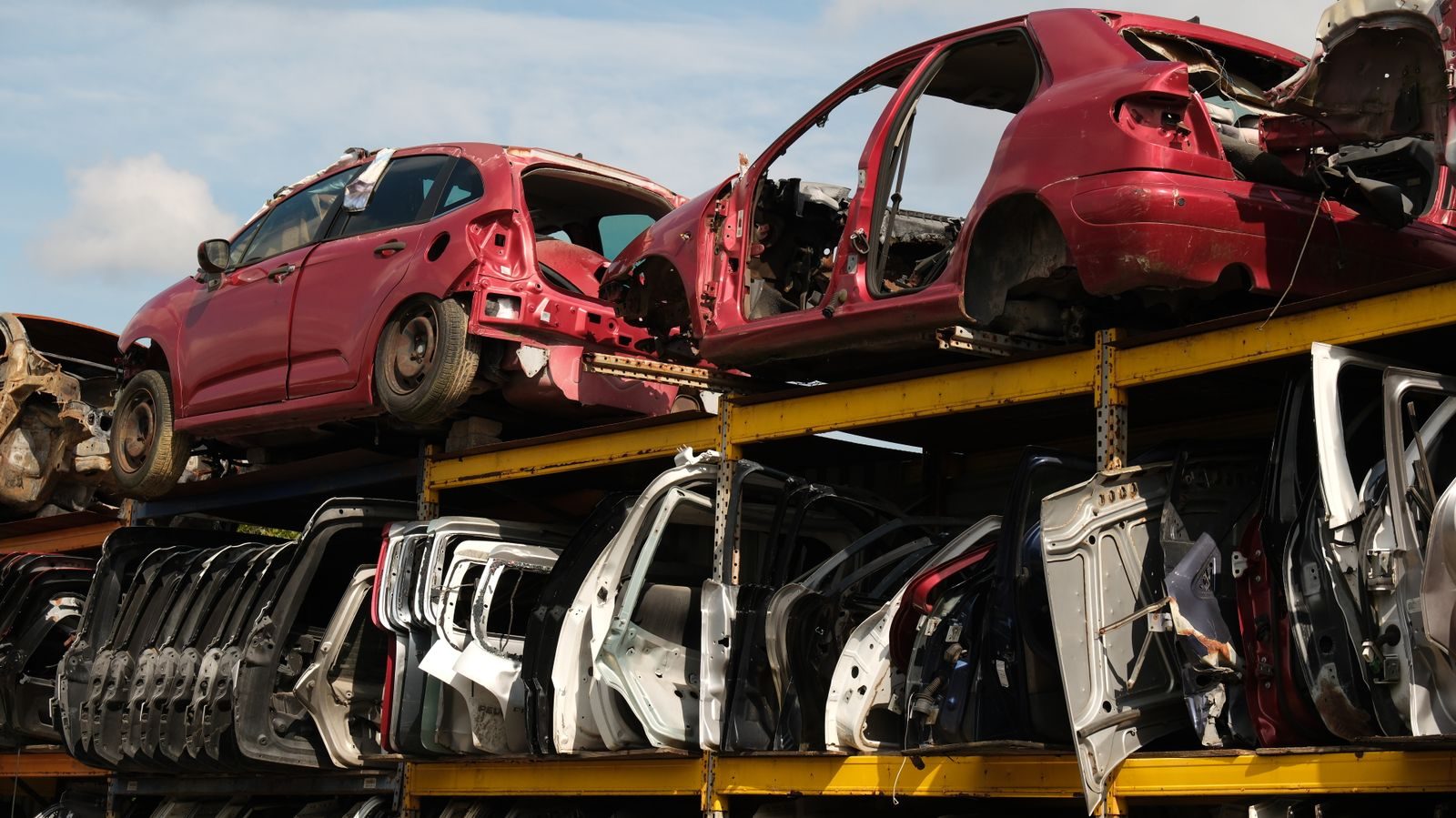
A collection of stacked abandoned car shells in an outdoor junkyard on a sunny day.

Renew Vs Scrap Vs New

๐Ÿ“š Educational Guide ยท COEPLUS.COM

Renew COE vs Scrap vs Buy New: The Full Cost Comparison

โฑ 7 min read๐Ÿ“… Updated June 2026โœ… Verified by COEPLUS Team

Homeโ€บResourcesโ€บRenew vs Scrap vs Buy New

Your Three Options at COE Expiry

When your vehicle’s COE expires, you face a significant financial decision. The three options are:

Option What It Means Upfront Cost
Renew COE (10 years) Keep your vehicle with a new 10-year COE 100% of current PQP (~S19,432 for Cat A)
Renew COE (5 years) Keep your vehicle with a shorter 5-year COE 50% of current PQP (~S9,716 for Cat A)
Scrap and buy new Deregister your vehicle, claim PARF rebate, buy a new vehicle Full cost of new vehicle (S30,000โ€“S50,000+)
Scrap without replacement Deregister, claim PARF rebate, no new vehicle Nothing โ€” you receive a rebate
Most car owners choose to renew rather than buy new, primarily because the total cost of renewal (even at full PQP) is typically far lower than the total cost of purchasing a new vehicle โ€” especially given Singapore’s high ARF and additional registration fees.

Understanding PARF and ARF

To compare the options fairly, you need to understand two acronyms that significantly affect the maths:

PARF Rebate (Preferential Additional Registration Fee)

When you scrap or export your vehicle before it is 10 years old, LTA refunds a portion of the ARF you paid when the vehicle was first registered. This is called the PARF rebate.

  • The PARF rebate is calculated based on the vehicle’s age at deregistration
  • A vehicle deregistered at exactly 10 years old (when the first COE expires) gets ~50% of the original ARF back
  • Once you renew the COE, you permanently forfeit the PARF rebate โ€” it is gone
Important: Once you renew your COE, you can never claim the PARF rebate for that vehicle, regardless of when it is eventually scrapped. This is a permanent, irrecoverable loss that must be factored into your decision.

ARF (Additional Registration Fee)

ARF is a tax paid when a vehicle is first registered in Singapore. It is calculated as a percentage of the Open Market Value (OMV) of the vehicle. For most passenger vehicles, ARF is 100% of OMV or higher โ€” so a car with an OMV of S0,000 pays S0,000+ in ARF at registration.

Full Cost Comparison

Let’s compare all options for a Cat A vehicle with a 10-year-old COE expiring now. Assumptions: OMV S5,000, ARF paid at registration S5,000, current Cat A PQP S19,432.

Cost Item Renew 10yr Renew 5yr Scrap + Buy New
COE cost S19,432 S9,716 ~S19,432 (new car)
New vehicle price (excl. COE) โ€” โ€” ~S0,000+
ARF on new vehicle โ€” โ€” ~S5,000+
PARF rebate received S/bin/sh (forfeited) S/bin/sh (forfeited) +S2,500 (50% of ARF)
Loan interest (7yr, 2.48%) ~S,280 ~S,640 ~S5,000+
Estimated total cost ~S26,712 ~S3,356 ~S20,000+
Monthly payment (7yr loan) ~S,511 ~S56 ~S,500+

โš  Figures are illustrative. New vehicle prices vary significantly. Consult COEPLUS for a personalised comparison.

๐Ÿ“Œ In this example, renewing the COE for 10 years costs approximately S3,000 less than buying a new equivalent vehicle โ€” a saving of over 40%.

The Case for Renewing

Renewing makes financial sense in most cases because:

  • Total cost is substantially lower โ€” you avoid the ARF, dealer margins, and full new vehicle price
  • You know your vehicle โ€” its service history, quirks, and condition are known quantities
  • No depreciation shock โ€” a new vehicle depreciates most steeply in its first few years
  • Lower insurance premiums โ€” your No Claims Discount (NCD) is already established
  • Lower monthly payments โ€” even at full Cat A PQP, renewing costs roughly S,511/month vs S,500+ for a new equivalent

The Case for Buying New

Despite the higher cost, buying new may be the better choice if:

  • Your vehicle needs major repairs โ€” if you face a large upcoming repair bill (engine, transmission, bodywork), the cost equation shifts
  • You want an EV โ€” the EV market in Singapore is maturing rapidly, and switching to electric now locks in lower running costs
  • Your vehicle is high-mileage โ€” reliability risk increases on high-mileage vehicles, and unexpected breakdowns add unplanned costs
  • You want modern safety and tech features โ€” lane assist, automatic emergency braking, and connected car features in newer models have real value
  • COE prices are very low โ€” if COE prices are near historic lows, a new vehicle becomes relatively more attractive
The repair threshold rule: As a rough guide, if your vehicle requires repairs costing more than 6 months of the equivalent new vehicle’s monthly loan repayment, buying new starts to make comparative sense.

How to Decide

Question Favours Renewal Favours Buying New
Vehicle condition? Good, well-maintained, low mileage High mileage, known issues, major repairs pending
Budget flexibility? Prefer lower monthly payment Can afford higher monthly cost for a newer vehicle
Driving needs? Same as current vehicle Need different size, towing, EV, or safety features
COE price environment? Current PQP is average or high COE prices are near historic lows
Planning horizon? Stable situation, no major life changes Expecting family expansion, career move, etc.
COEPLUS recommendation: For the majority of Singapore vehicle owners with a well-maintained vehicle, COE renewal is the more financially sound decision. The savings vs buying new are substantial. Use our free Calculator and AI Advisor to run the numbers for your specific situation before deciding.

Get a Personalised Renewal vs New Vehicle Analysis

Tell Chloe your vehicle details and she will help you compare the real numbers for your situation.

Read More...